
A dog’s true happiness and counterfeit “happiness.”
A dog will never be happy if their guardian does not understand what canine happiness really means…
Sadly, in today’s crazy times, with so many people on social media practically competing to post ever more foolish and dreadful photos and videos of their animals, people unfamiliar with canine psychology struggle to work out what is good for animals and what is not, what makes a dog happy and what does not.
Many people already know that for dogs to develop properly, mentally and physically, they need above all understanding, respect, peace, thoughtful teaching, wise guidance through life and, most of all, to be who they are: dogs. Yet what is very sad, distressing and worrying is the sight of dogs deprived of exactly what they need most. Human whims and stupidity are literally racing each other.
We have all surely seen bewildered dogs with bulging eyes, panting with an infantilized expression, wearing birthday hats and seated at a table beside a cake bearing a message such as: “Oh, I’m so happy and joyful because my mommy threw me a birthday party.” And, of course, an absurdly sugary caption completely misrepresents the actual situation while everyone raves about the wonderful mommy celebrating her doggy’s birthday.
No one notices—especially with a “clever” caption—that the dog is not enjoying it at all, feels awful in that situation and shows terrible discomfort, profound confusion and a desire to escape. But behind the scenes “mommy” probably ordered the dog to sit, so sit they must.
Some time later, the same “happy and understood” little dog appears in a video writhing and struggling on a prong collar. But “mommy” adds a caption along these lines: “I felt spring in the air today, so I’m jumping around joyfully, dancing, spinning and pulling hard because I want to get to my favorite place already. I’m hurrying mommy along, but mommy wants to dance with me a little longer.”
Naturally, there are oohs and aahs over this foolishness, while few notice a severely overstimulated dog completely unable to cope with their emotions, trying to escape the pain of the prong collar digging in. Does anyone really think that an ordinary, understood, thoughtful, emotionally stable dog allowed to be themselves would lunge like that on a walk, struggle so hard, or dance?? And if “mommy” truly loves the dog and wants the best for them, would she yank them around on a prong collar??
The truth is that “mommy” cannot cope at all with her troubled dog on walks. Instead of waking up from this unhealthy world of false reality and asking whether her dog is truly happy and where these problematic behaviors come from, she prefers to pretend everything is “great.” Through her dreadful treatment she pushes the dog into even deeper trouble, destroying their canine dignity and turning them into a clown.
Later, that same “mommy” shows her dog in a highly uncomfortable encounter with another dog. Both dogs signal with their whole bodies that they do not want to be together. Of course, there is another sugary caption: “Walks are best with my doggy friend.” And, naturally, everyone marvels at this “canine friendship.” That “friendship” consists of two dogs doing everything they can to avoid each other, without support from guardians who keep forcing them into a deeply uncomfortable situation.
Another “highlight” is when “mommy” shows her beloved little dog locked in a crate at home, all neatly built into the furniture, with a caption saying that her wonderful darling chose this little house because he feels bad moving around the apartment normally and prefers to stay in his crate all the time. I will not repeat the foolish praise heaped on such nonsense. But does anyone, even without knowing canine psychology, seriously think the dog chose a built-in furniture crate so everything would match the apartment’s decor???
From my professional experience I know two possibilities. Either the dog is not allowed to move around the apartment, or they really do retreat to the crate to get some peace from their owner. As I always write, I have nothing against crates at home, because sometimes they really are needed—for example, to restrict a dog’s movement immediately after major surgery when movement is completely prohibited. But that is temporary, not how a dog’s whole life should look. Does anyone really believe dogs dream of being locked in crates at home for long hours???
When dogs can—and above all when they have peace and are understood and respected—they love being close to their beloved human, staying near them, lying beside them, cuddling them, or simply resting somewhere nearby, preferably up on something because dogs really like that. They do not want to be locked in crates for hours. Sadly, many “experts” practically order guardians to have crates. No one pauses to ask what kind of expert, supposedly concerned about a dog’s mental and physical development, orders them kept in a crate while offering dreadful arguments based on “performed, false concern for the dog.”
Is that really concern for the dog?? Or is it persuading willing listeners, at the dog’s expense, that this is how things must be, so the “experts” at least have one less problem: people will not complain that the dog makes a mess or destroys things at home, because they can put them in a crate. Then comes some drilling and pointless “tricks” dictated by the “expert.” The dog remains misunderstood, unhappy and frustrated, but never mind… Everyone pretends it is “wonderful.” It is also worth checking whether an “expert” recommending something as “wonderful and brilliant” for a dog—when it is really at the dog’s expense—stands to profit from promoting such nonsense…
So, in this crazy and sadly often dishonest world, anyone able to keep a clear head—and I mean empathetic people—who wants the best for their dog should always think carefully about what the dog needs, what makes them happy, and how to help when they need help. Remember: bewildered dogs with bulging eyes, infantilized expressions, panting in strange positions, forced into human behavior and used as living toys are not happy or joyful at all. It is like telling someone a fish placed high in a tree is happy because it is closer to the sun…
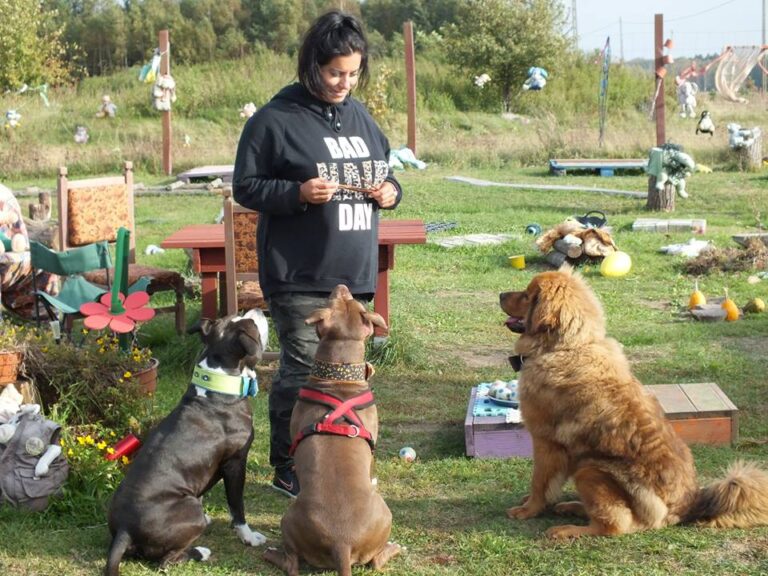
And our happy, understood, thoughtfully loved, proud and thinking canine teaching team sends everyone greetings from the environment they adore.