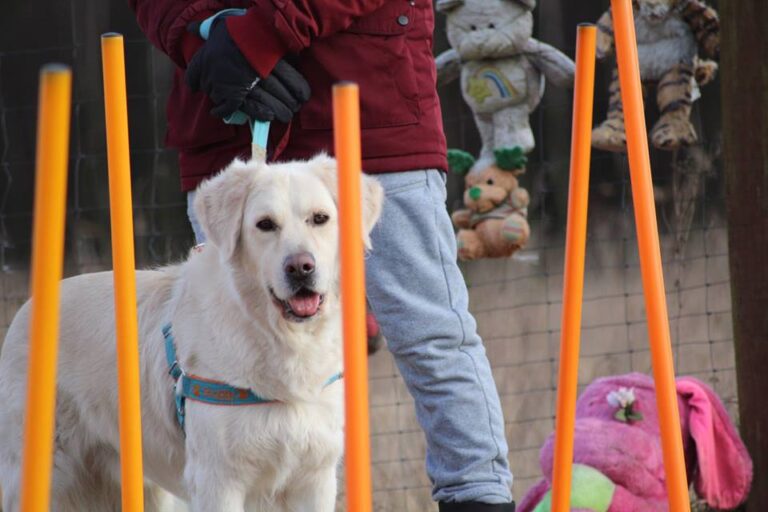

I have written about these disorders more than once. Sadly, our society still lacks adequate knowledge about them. Things are actually getting worse, especially because owners who do not understand the seriousness of the problem and the illness their dog suffers from turn it into entertainment. They harm their dog badly in doing so, and this ignorance—and often human stupidity—is then passed on. This is particularly common with bull terriers.
Canine compulsions and obsessions.
Sadly, a great many owners have no idea how serious this illness is for a dog’s mind and, subsequently, their body. A similar condition is also very common in people. Canine compulsions, or Canine Compulsive Disorder, include, for example, an individual repeating the same actions over and over without any meaningful purpose.
A dog suffering from CCD does not have an easy life and struggles terribly with it.
But to someone unfamiliar with the condition, it often looks as though the dog is playing. Owners may even be pleased because the dog does not bother them and can occupy themselves for hours. Until that changes.
Common signs include:
- The dog chases their tail in circles;
- The dog continually tries to catch something in the air even though nothing is there;
- The dog keeps spinning, stops briefly, then returns to it, again and again;
- The dog repeatedly initiates activities with balls, sticks, stones or other objects;
- The dog looks everywhere and at everyone for an object to snatch—for example, a ball-fixated dog may see balls everywhere and try to grab them from anyone;
- The dog licks parts of their body, objects or their owner for very long periods;
- The dog repeatedly “hunts” shadows and tries every possible way to catch them, often injuring themselves badly in the process;
- The dog repeatedly runs back and forth along the same stretch, such as a fence;
- The dog often picks up an object, such as a ball, stick or stone, carries it elsewhere and creates a “challenge” by pushing it under furniture or into a sofa, then trying to retrieve it, repeating this very frequently;
All these stereotyped behaviors severely tire and exhaust the dog mentally and physically and are closely linked to many other issues. Dogs suffering from CCD become very nervous, cannot focus on many activities and may often toilet indoors in an attempt to release unwanted emotions.
In many cases aggression develops because the body is being exhausted. The dog is constantly “ready” and must respond to psychological demands—for example, the need to catch a shadow. Repeatedly chasing a ball, shadows or their own tail, or spinning in so-called pirouettes, requires effort and the mobilization of energy reserves. If highly exhausting behaviors recur continually, we begin to see distress. The body’s current resources no longer suffice to meet the biological costs of the stress response, so resources are diverted from other physiological functions. Distress reduces the dog’s overall welfare.
That is why dogs suffering from CCD often have various illnesses whose occurrence is not linked to their CCD.
Many dogs with CCD do not eat as they should or have no appetite at all. Dogs with CCD can hurt themselves because, while carrying out their fixated behaviors, they do not think, cannot control themselves, have no self-control and “drift away” into their own world. That is why we must not dismiss such unwanted behavior or tell ourselves it is normal and how things should be. To me, bull terriers are particularly badly affected, because they so often suffer from CCD. These dogs struggle terribly with their fixations while people think they are enjoying themselves. We often hear:
“Well, it’s a bull terrier,” and the “famous” expression “pig hour.” One person starts it, another follows, a “crowd” forms, and everyone assumes that a bull terrier racing wildly around or spinning is playing. Genetics matters greatly in these breeds. Research is increasingly being carried out that confirms the presence of a gene responsible for certain behaviors and its subsequent transmission to offspring. But genetics cannot take all the “blame.”
Dogs often develop various obsessions because they are not guided properly through life, because more is demanded of them than they can bear, because they are punished, excessively humanized and consciously or unconsciously burdened with human emotions. Owners push dogs into problems themselves—for example, by continually making them chase a ball or a moving light.
Remember: if we notice worrying symptoms in our dog, we must act!
An emotionally stable dog of sound mind will never, of their own accord, behave like a lunatic. Dogs do not want or need this at all. It is not normal for a dog to keep doing and repeating something and be unable to do without it. A mentally and physically healthy dog does not need such behavior. And let us not assume that because someone shows their dog with a serious problem and is pleased about it, it must be right and great fun. Perhaps it is for an unaware person who has not learned about the subject, but not for the poor dog.
Sadly, many people prefer to turn a problem into “fun,” perhaps because that makes life easier for them, convincing themselves the dog is having a wonderful time. Also, simply owning a dog—or having owned several—proves nothing and does not make someone an expert in canine psychology. Likewise, someone breeding a particular breed may know absolutely nothing about canine psychology, and may turn a problem into “fun” to sell the “goods” more easily. Or offer cruel advice that the dog should be beaten for everything they do wrong, because that is what the breed needs.
Remember: if our dog repeatedly runs around with a ball, chases shadows or spins in circles, that is neither normal nor any kind of fun. Let us act to help our dog, because they are suffering greatly. Such a serious problem will not disappear by itself; it will intensify significantly.
When CCD is already very advanced, there is hard work ahead. Helping a dog recover is extremely difficult and lengthy, and not always possible. The owners have a very important part to play. Psychotherapeutic treatment of obsessive-compulsive disorders uses cognitive behavioral therapy as far as possible. But this requires extensive analysis and observation of the dog’s behavior. Many things need to be removed, many changes made, and the dog must be skillfully prepared during rehabilitation sessions, learning to cope with and tolerate exposure to stimuli that trigger or intensify compulsions and obsessions. As I mentioned earlier, the owners play an enormous role throughout the therapy.